
A concrete driveway in Cornwall has to carry vehicles through freeze–thaw winters, road salt and spring meltwater, so the base and slope matter as much as the concrete. Cornwall Concrete Contracting installs new driveways and replaces cracked, sunken or worn ones across Cornwall and Eastern Ontario. This page covers when to replace, how we build, finish options and what affects the cost.
When does a driveway need replacing instead of repairing?
A driveway needs replacing when sections have sunk or lifted, cracks run across most panels, the surface is scaling badly, or water pools against the garage or house. Those signs point to a failed base or a slab that was too thin, and patching the surface leaves the cause in place.
Driveway repair still makes sense on a slab that is level and well supported. Sealing isolated cracks, rebuilding a broken joint or cutting out and repouring one damaged panel can add years of service. We tell you which approach fits after looking at the driveway, not before.
How do we build a concrete driveway on Cornwall clay?
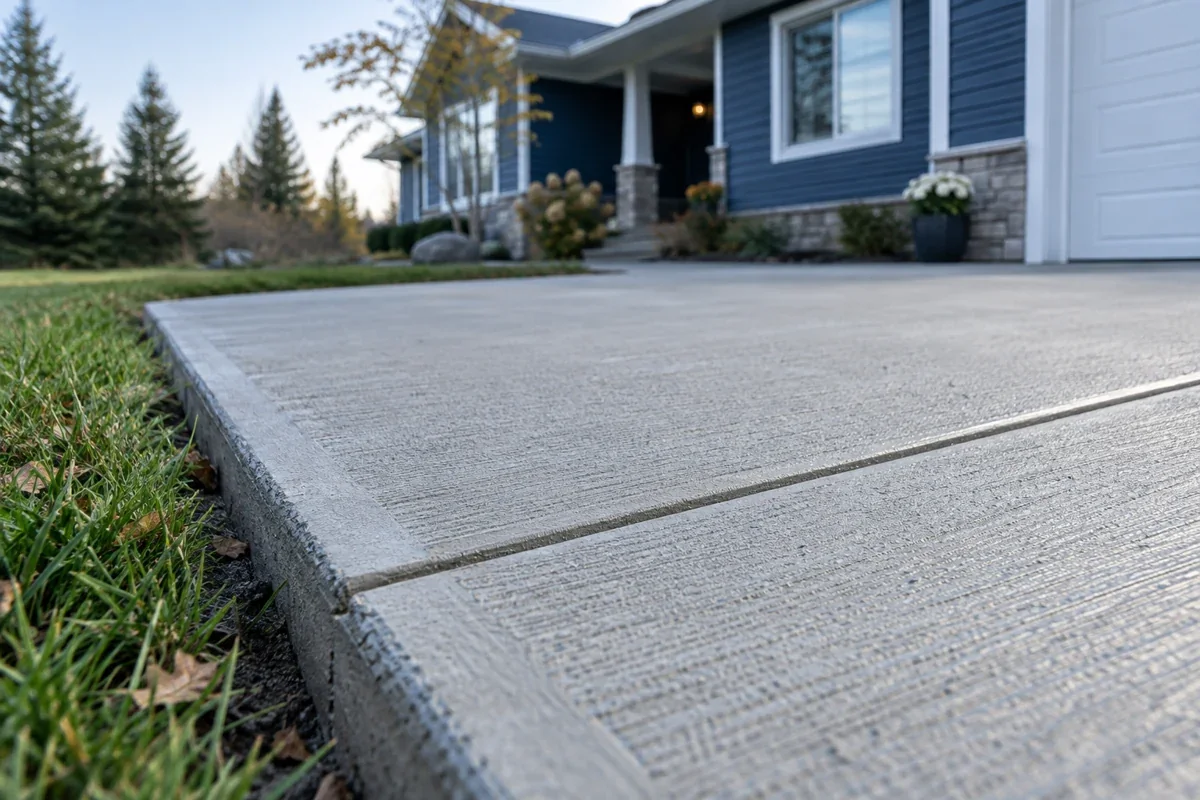
We build a concrete driveway on Cornwall clay by removing the old surface, digging out soft or organic soil and replacing it with compacted granular base laid in layers. Clay holds water and heaves when it freezes, so the depth of base work depends on what we find when we dig, not on a standard number.
Forms are then set to fall away from the garage and toward the street or a planned outlet. Reinforcing is placed where the slab needs it, outdoor air-entrained concrete is poured and finished, and control joints are cut so shrinkage cracks happen in straight lines instead of across the middle of a panel.
How thick should a concrete driveway be?
A concrete driveway should be thick enough for the heaviest vehicle that will use it, which for most family cars and pickups is a standard residential slab, and thicker with added reinforcing for motorhomes, loaded trailers or work trucks. Thickness alone does not prevent cracking; a firm, well-drained base does most of that work.
Tell us everything that will park on the driveway, including delivery trucks and the occasional fuel or propane truck on rural properties. We thicken the edges and the apron where wheels cross from the street, because those are the spots that break first.
Which finish suits your driveway: broom, stamped or exposed aggregate?
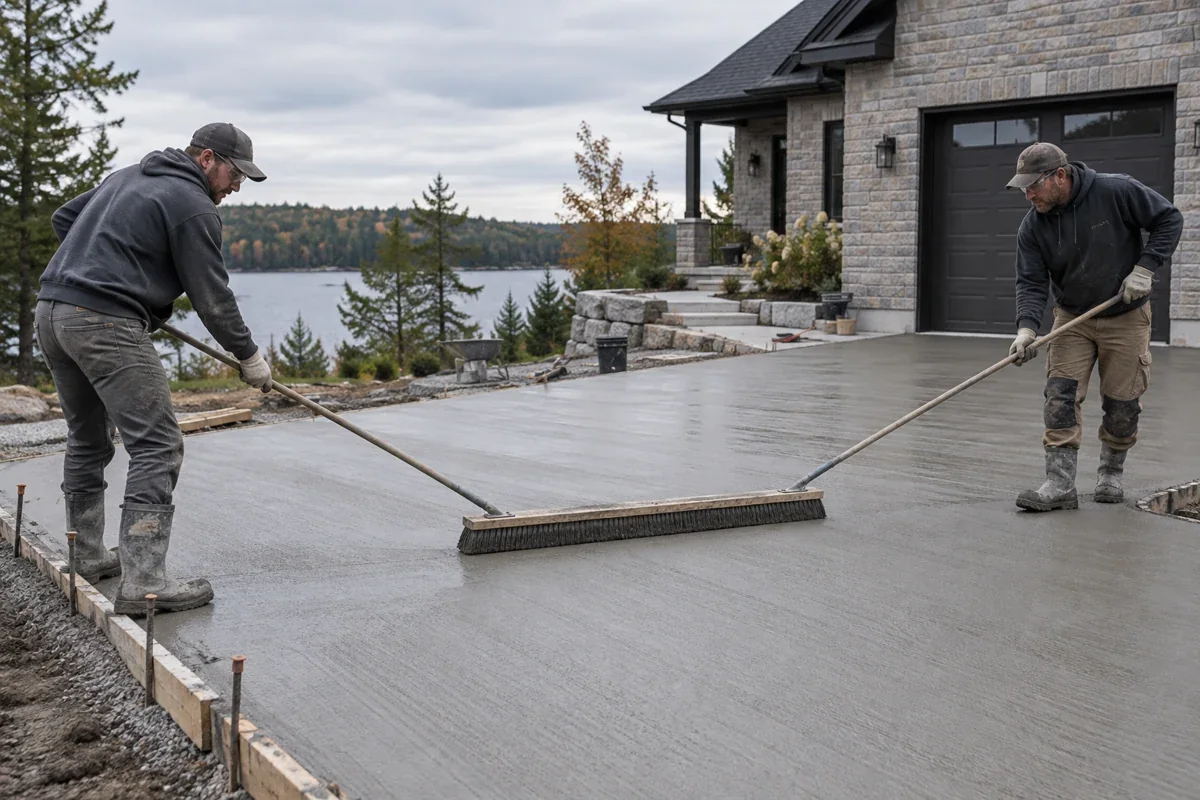
A broom finish suits most driveways because it gives good traction in rain and snow at the lowest cost. Stamped concrete adds a stone or slate pattern with colour, and an exposed aggregate driveway shows the natural stone in the mix for a textured, non-slip surface that hides tire marks well.
Stamped driveways need resealing every few years and can be slick when wet if left unsealed or sealed with a glossy product without grit. Exposed aggregate wears well under salt when it is sealed. Many owners pair a broom-finished driveway with a decorative border or walkway to control the cost.
Is concrete or asphalt better for a Cornwall driveway?
Concrete is better for a Cornwall driveway when you want a long service life, a light surface and low maintenance, while asphalt costs less up front and is quicker to repair. Asphalt needs regular sealing and softens in summer heat; concrete stays firm but needs careful curing and protection from salt in its first winter.
If you are replacing asphalt with concrete, the existing gravel base is checked and usually rebuilt, because asphalt bases are often thinner than concrete needs. If you are planning a design discussion, driveway layouts from other regions can help you explain the appearance you want, but a photograph does not establish the specifications for your property. If you are looking at work described by concrete contractors in Pine Hills, identify the layout, edges and finish you like. The dimensions, vehicle use, drainage and site conditions for your Cornwall driveway still need their own assessment.
How much does a concrete driveway cost in Cornwall?
The cost of a concrete driveway in Cornwall depends on its size, how much old asphalt or concrete has to be broken out and hauled away, the base work your soil needs, the thickness and reinforcing for your vehicles, and the finish. Access for the concrete truck and the number of curves, steps or connections to walks also change the labour.
Your free estimate lists removal, excavation and base, forming and reinforcing, concrete, finishing and clean-up separately, so you can compare driveway quotes line by line. A rough sketch with measurements and photos of the current driveway lets us prepare it quickly.
How should you care for a new concrete driveway?
Care for a new concrete driveway by keeping vehicles off it until we confirm it is ready, usually about a week for cars, and longer for heavy trucks. Keep it damp-cured or covered as instructed, and avoid de-icing salt for the whole first winter; sand gives traction without the damage.
After that, rinse off salty slush in spring, keep joints clear of weeds and soil, and reseal decorative finishes when water stops beading on the surface. Watch for water pooling near the garage, which is the first sign that something beneath the driveway has changed.
Common questions about Concrete Driveways in Cornwall
How long does a concrete driveway replacement take?
Removal and base work usually take a day or two, the pour and finish one day, and curing about a week before cars. Weather and size change the schedule.
Can you pour a new driveway over the old one?
Rarely. Pouring over a failed slab copies its cracks and raises the height at the garage. We remove the old surface and rebuild the base.
Should a concrete driveway be sealed?
A penetrating sealer helps a broom-finished driveway resist salt; stamped and exposed aggregate driveways should be sealed and resealed every few years.
What drives the cost of a driveway?
Size, removal of the old surface, base depth, thickness, finish and access. Your free estimate itemizes each of these.
Ready to plan your concrete project?
Call (343) 500-2207 or send the form. Estimates are free and in writing, and photos of the area help us prepare.